A Mexican restaurant in Scotland, part of a restaurant group, switched to Sidedoor and asked guests to save a card when they book. Comparing 31 August to 30 October 2026 with the same weeks of 2025, no-shows halved, from 6.8% to 3.4% of seated bookings.
We are not naming the restaurant or its group, so this post describes what it did rather than who it is. The figures come from its own booking data.
About the restaurant
It is a Mexican restaurant in Scotland and one of the venues in its group. It took around 4,000 bookings between 31 August and 30 October 2026, and around the same number in those weeks of 2025.
Like most restaurants that take bookings, its margins depend on the tables it holds for guests actually being filled. A table held for a party that never arrives is a table that could have gone to a walk-in or someone on the waiting list.
The challenge
Before Sidedoor, two things weren’t working for the group.
First, deposits were not reliably captured. A policy is only as good as its enforcement, and when the deposit step doesn’t happen consistently, guests learn that a booking costs them nothing to abandon. That is where no-shows creep in.
Second, the group had a separate login for each venue. Checking on another restaurant in the group meant signing in to a different account.
What they set up
The restaurant moved its bookings to Sidedoor reservations and chose card on file as its payment policy.
Card on file, not an upfront deposit
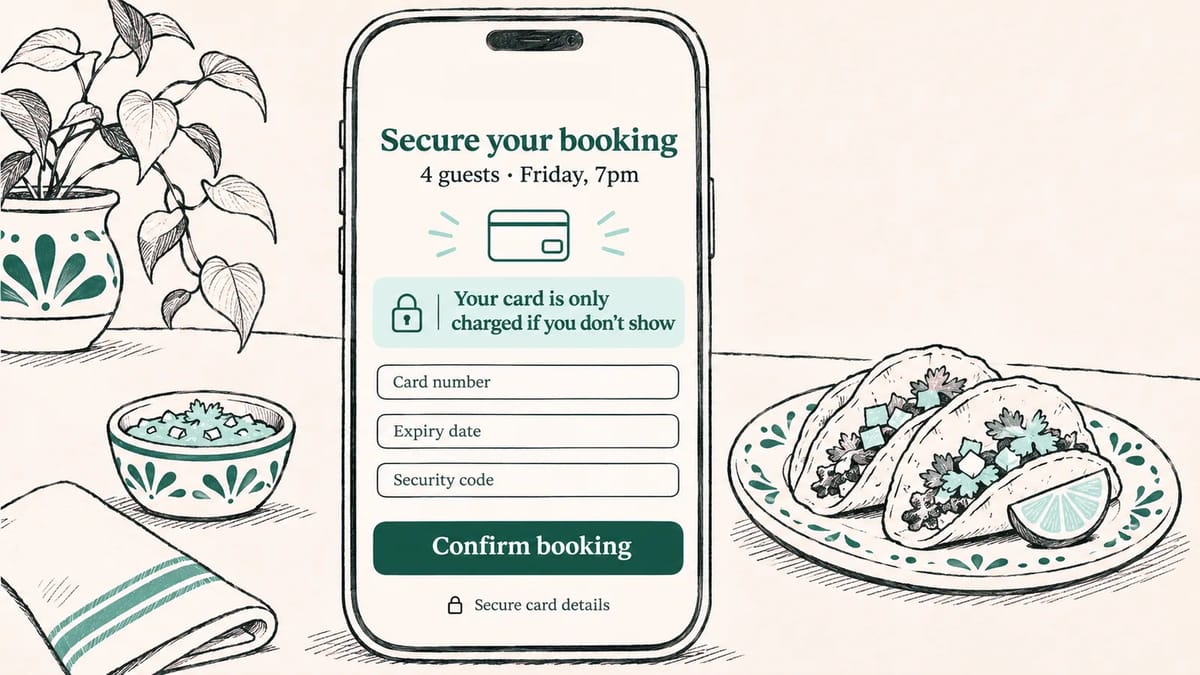
With card on file, the guest saves a card when they book. Nothing is charged at that point. The card is only charged if the guest doesn’t turn up, or cancels late, inside the cancellation window the restaurant sets.
That is a softer ask than taking money upfront. A guest who turns up as planned never pays anything through the booking, so the step costs honest guests nothing. A guest who might otherwise drift away without cancelling now has a reason to let the restaurant know.
The policy is set in the payment policy editor, where the restaurant picked card on file as the policy type. On Sidedoor payments, deposits, minimum spends and card on file can be set per service, so a venue can ask for a card on its busiest nights and keep a quieter service open with no card at all.
What the guest and the team see
When a guest books with a card, the booking shows “Card saved, nothing charged now”, so the team knows where it stands before the guest arrives.
If a guest doesn’t turn up, the no-show charge is recorded in the booking’s History, alongside everything else that has happened to that booking. Charges settle through Stripe Connect straight to the venue’s own account.
One login for the group
Moving to Sidedoor also ended the separate login per venue. In Sidedoor every venue in a group rolls up to one account, so a manager can see each site from the same login. The multi-venue tools are what the group now uses to look across its restaurants.
The results
The restaurant compared 31 August to 30 October 2026 with the same weeks of 2025. Each period had around 4,000 bookings.
| Measure | 31 Aug to 30 Oct 2025 | 31 Aug to 30 Oct 2026 |
|---|---|---|
| No-shows, as a share of seated bookings | 6.8% | 3.4% |
| Share of bookings made online | 50% | 57% |
| Bookings carrying a card on file | n/a | 57% |
- 2025
- 2026
| 2025 | 2026 | |
|---|---|---|
| No-shows (share of seated bookings) | 6.8% | 3.4% |
| Bookings made online | 50% | 57% |
Source: The restaurant's booking data, 31 Aug to 30 Oct 2025 and 31 Aug to 30 Oct 2026, supplied by the venue
No-shows halved
No-shows fell from 6.8% to 3.4% of seated bookings. That is half the rate of the same weeks a year earlier, on a similar number of bookings.
Most bookings now carry a card
57% of bookings now carry a card on file. Those are bookings where a guest has agreed, in advance, that a no-show or late cancellation has a cost.
More guests booking online
The share of bookings made online rose from 50% to 57% over the same comparison. The online share went up, not down, with the card step in place.
What other restaurants can take from this
If no-shows are costing you tables, a few points from this restaurant apply to most venues:
- Make the policy happen every time. The problem before was not the policy, it was that deposits were not reliably captured. A rule that is applied automatically at booking does more than a stricter rule applied now and then.
- Ask for a card, not money. Card on file asks guests for commitment without charging the ones who turn up.
- Set the policy per service. Start with the services where no-shows hurt most, then widen it if it works.
- Measure like for like. Compare the same weeks year on year, as this restaurant did, so seasonal swings don’t flatter or hide the result.
If you run more than one site, it is also worth counting how many logins your team juggles. One account across the group is one less thing to manage on a busy night. You can see how Sidedoor handles this for restaurants.
Frequently asked questions
What is card on file for restaurant bookings?
The guest saves a card when they book and nothing is charged at that point. The card is only charged if they don't turn up or cancel inside the venue's cancellation window.
Does card on file reduce restaurant no-shows?
For this Mexican restaurant in Scotland it did. No-shows fell from 6.8% to 3.4% of seated bookings between 31 August and 30 October 2026, against the same weeks of 2025.
Can I set a different payment policy for different services?
Yes. In Sidedoor you set deposits, minimum spends and card on file per service, so a busy Saturday can carry a different policy from a quiet weekday lunch.
Can one login cover every venue in a restaurant group?
Yes. In Sidedoor every venue in a group rolls up to one account, so managers see each site from a single login instead of one login per venue.
Run bookings, guest lists and events on Sidedoor.
See how it works